Traditional security measures like firewalls and antivirus software are no longer enough to combat today’s sophisticated threats. Organizations need a proactive, intelligence-driven approach that not only detects threats in real-time but responds instantly before damage occurs. That’s where Managed Detection and Response (MDR) transforms your security posture.
The Evolving Cybersecurity Threat Landscape
Businesses face an unprecedented array of cyber threats that are growing in both sophistication and frequency:
Top Cybersecurity Threats Businesses Face Today
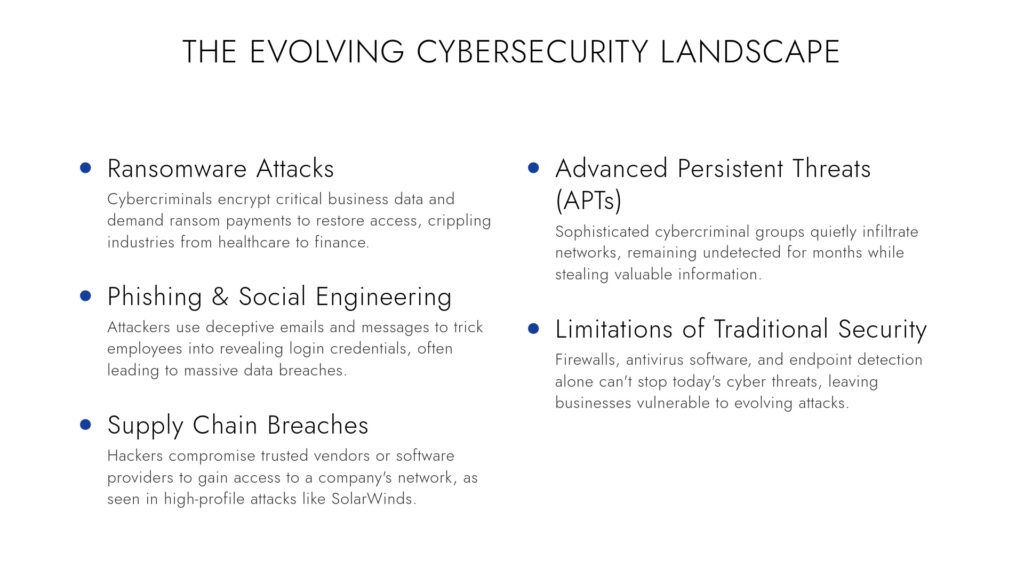
- Ransomware Attacks: Cybercriminals encrypt critical business data and demand ransom payments to restore access. High-profile attacks have crippled industries from healthcare to finance.
- Phishing & Social Engineering: Attackers use deceptive emails and messages to trick employees into revealing login credentials, often leading to massive data breaches.
- Supply Chain Attacks: Hackers compromise trusted vendors or software providers to gain access to a company’s network, as seen in high-profile breaches like SolarWinds.
- Advanced Persistent Threats (APTs): Sophisticated cybercriminal groups quietly infiltrate networks, remaining undetected for months while stealing valuable information.
💡 Key Insight: Traditional security measures are reactive, not proactive. They often detect threats after they’ve already infiltrated the network, leaving businesses scrambling to contain the damage.
Why Traditional Security Falls Short
Many organizations rely on traditional security tools like firewalls, antivirus software, and endpoint protection to guard against cyber threats. While these measures play a role in defense, they lack the agility, visibility, and proactive response needed to combat today’s sophisticated attacks.
The Limitations of Traditional Security
- Reactive, Not Proactive – Traditional security solutions often detect threats after they’ve already infiltrated the network, leaving businesses scrambling to contain the damage.
- Alert Fatigue & False Positives – Security teams are bombarded with alerts, many of which turn out to be false positives. This overload leads to critical threats being overlooked.
- Lack of 24/7 Monitoring – Cybercriminals don’t operate on a 9-to-5 schedule. Without round-the-clock surveillance, businesses are vulnerable to attacks that go unnoticed outside of working hours.
- Resource Constraints – Maintaining an in-house Security Operations Center (SOC) with skilled analysts, cutting-edge threat intelligence, and rapid response capabilities is costly and complex.
- Evolving Threats Bypass Legacy Defenses – Cybercriminals use AI-driven attacks, zero-day exploits, and advanced persistent threats (APTs) that can bypass traditional security tools.
The Need for a Smarter, Stronger Security Solution
Modern threats demand modern security solutions. Organizations need a cybersecurity approach that:
- ✅ Detects and responds to threats in real-time – not after an attack has already succeeded
- ✅ Leverages AI and expert human analysis to reduce false positives and identify real threats faster
- ✅ Provides 24/7 monitoring and response to ensure attacks are stopped immediately
- ✅ Integrates with existing security tools to enhance overall protection without disrupting business operations
This is exactly what Managed Detection and Response (MDR) delivers.