Home/Blog/Cybersecurity/Cybersecurity for CEOs | Protect Your Business Now
Cybersecurity

Cybersecurity for CEOs | Protect Your Business Now

Cybersecurity for CEOs | Protect Your Business Now

Get your book today!

The book is now available for purchase everywhere great books are sold.

[

Ingram Spark

](https://shop.ingramspark.com/b/084?params=CDhlAXVWHwLvM8ee8lVqX71nVLfjoZn0U9rlgTAV4wR)

[

Barnes & Noble

](https://www.barnesandnoble.com/w/cybersecurity-for-ceos-sean-p-conroy/1147741605?ean=9798999243102)

[

Amazon

](https://www.amazon.com/Cybersecurity-CEOs-every-business-leader/dp/B0FG5C3Q27)

What you will learn

Explore a wide range of topics geared toward business leaders

Image: pexels-august-de-richelieu-4428041-1024x683.jpg

Speak the Language of Cybersecurity

Demystify the jargon and learn how to ask the right questions. Gain the confidence to engage with your IT and security teams without needing to be a technical expert.

Image: pexels-alphatradezone-5833767-1024x683.jpg

Protect Your Business from Costly Mistakes

Understand the real risks facing small and mid-sized companies. Learn how breaches actually happen, what they cost, and how to avoid them through smart strategy.

Image: pexels-fauxels-3184427-1024x683.jpg

Build a Culture of Cyber Resilience

Turn cybersecurity from a compliance headache into a competitive advantage. Develop policies, playbooks, and leadership habits that make security part of your company’s DNA.
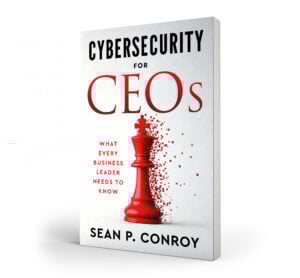
Image: CyberCEO-rendering-300x278.jpg

Discover the Story

About the book

In today’s hyper-connected world, cybersecurity is no longer just an IT issue — it’s a business survival issue.

Cybersecurity for CEOs is a clear, no-nonsense guide written specifically for business leaders responsible for protecting their organizations but who don’t have the time to become security experts. Whether you’re running a small business or leading a growing enterprise, this book will help you understand the real risks, ask the right questions, and lead with confidence.

Drawing on years of experience advising companies at every stage, Sean P. Conroy offers a practical framework for making cybersecurity a boardroom priority. Inside, you’ll find real-world stories, plain-English explanations, and actionable checklists designed to help you reduce risk, improve resilience, and avoid costly mistakes. If you’re a CEO, founder, or executive who wants to lead on security, without getting lost in the weeds, this book is for you.

Get your copy now!

Cybersecurity for CEOs is now available everywhere great books are sold.

[

Ingram Spark

](https://shop.ingramspark.com/b/084?params=CDhlAXVWHwLvM8ee8lVqX71nVLfjoZn0U9rlgTAV4wR)

[

Barnes & Noble

](https://www.barnesandnoble.com/w/cybersecurity-for-ceos-sean-p-conroy/1147741605?ean=9798999243102)

[

Amazon

](https://www.amazon.com/Cybersecurity-CEOs-every-business-leader/dp/B0FG5C3Q27)

Image: 7209_SD-HEADSHOTS-1024x683.jpg

Discover the Story

About the author

Sean P. Conroy is a seasoned technology leader with over two decades of experience helping companies navigate complex cybersecurity challenges.

As the former head of technology at a $250M e-commerce company and the lead architect at a billion-dollar airline, Sean has led teams through digital transformation, cloud migration, and high-stakes incident response.

Today, he advises CEOs and boards on cyber risk, resilience, and strategy through his firm, Inventive HQ. Cybersecurity for CEOs reflects his mission: to make cybersecurity clear, actionable, and accessible for business leaders who can’t afford to get lost in technical jargon.

Frequently Asked Questions

Find answers to common questions

CEO must decide: risk tolerance (how much to spend on security vs accept risk), incident response authorities (who can authorize paying ransom, taking systems offline, notifying customers), compliance strategy (which frameworks to pursue—SOC 2, ISO 27001), cyber insurance limits ($1M vs $5M coverage). Delegate to IT/CISO: tool selection (which EDR, SIEM, firewall), technical implementation, day-to-day operations, vendor management. CEO involvement needed when: decision has business impact (spending $100K on security tools affects budget), legal/regulatory implications (breach notification, compliance), or reputation risk (customer notification, media response). Don't micromanage: daily security operations, tool configurations, technical details. Do set strategy: security budget, risk appetite, compliance goals, incident response authorities. Meeting cadence: monthly security updates (15-30 minutes), quarterly risk reviews (1-2 hours), immediate notification for critical incidents.

Industry benchmark: 5-15% of IT budget for cybersecurity (varies by industry—healthcare/finance higher, retail lower). For SMB with $500K IT budget: $25K-$75K annually for security. Breakdown: security tools (EDR, email security, backups—$15K-$30K), security assessments (penetration testing, risk assessment—$10K-$25K), training ($2K-$5K), cyber insurance ($5K-$15K). Minimum viable security (any business): EDR ($10K-$20K), email security ($3K-$10K), backups ($5K-$10K), training ($2K), insurance ($5K-$10K) = $25K-$52K annually. More if: regulated industry (add $50K-$150K for compliance), high-value target (add $30K-$100K for advanced monitoring), large company (costs scale with employees/systems). ROI calculation: average breach costs $150K-$500K, spending $50K annually on security to prevent breach pays for itself if it prevents one incident every 3-10 years.

Red flags: cyber insurance application rejected or premiums spiking 50%+ (indicates insurer sees high risk), compliance audits revealing gaps (SOC 2/HIPAA audit finds major deficiencies), staff bypassing security (using personal Dropbox because work tools are blocked/inconvenient), no testing (backups never restored, incident response never practiced), or security team of one (single person knows all passwords, no backup if they leave). Other warnings: can't answer basic questions (who has admin access to what? when did we last patch? where is our data?), multiple near-misses (caught malware infections by luck not monitoring), or regulatory pressure (customers/partners demanding security attestations we can't provide). If you see 3+ of these: immediate security assessment needed ($5K-$15K, 2-4 weeks). Don't wait for actual breach—these are warnings that incident is likely.

Full-time CISO ($150K-$300K+ salary) makes sense when: 500+ employees, heavily regulated industry (healthcare, finance, defense), frequent audits/compliance needs, or building security team (CISO manages multiple security staff). vCISO ($3K-$10K/month, 10-20 hours/month) makes sense when: under 500 employees, need strategic security leadership but not 40 hours/week, want flexibility (scale up/down as needed), or testing before full-time hire. vCISO provides: security strategy, risk assessments, board reporting, vendor management, compliance guidance, incident response leadership. Doesn't provide: day-to-day security operations (that's your IT team or MDR service). Break-even: vCISO at $5K/month = $60K/year vs full-time CISO at $200K+. For most SMBs: vCISO until you need full-time (usually around 200-500 employees or heavy compliance needs).

Cyber insurance with incident response coverage ($1M-$5M limits, $5K-$25K annually depending on revenue/industry). Why: breaches happen despite best security (ransomware success rate is high, human error is inevitable), insurance covers: ransom payment (if you choose to pay), forensics and recovery ($50K-$200K typical), legal fees ($25K-$100K), customer notification ($10K-$50K), business interruption losses. Insurance also provides: 24/7 incident response hotline (know who to call at 2AM), access to forensics experts (included in coverage), legal guidance (breach notification requirements), negotiation support (ransomware payment). Without insurance: breach costs $150K-$500K out of pocket. With insurance: covered minus deductible ($5K-$25K). Additionally: cyber insurance application forces security improvements (insurers require MFA, EDR, backups—implementing these reduces risk even without claim). This single decision—buying cyber insurance—often drives other security improvements and provides safety net when prevention fails.

Security Strategy for Executives

Our vCISO service translates technical security into business terms for board-level conversations.